
Reimagining the Red Centre
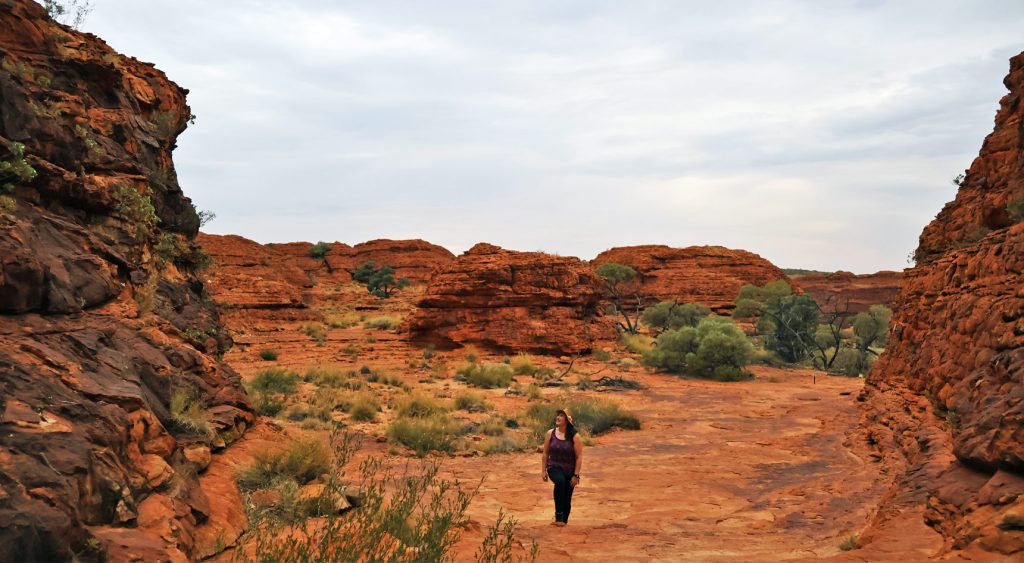
Alice Springs, Kings Canyon, Uluṟu – and the 500km between – form the beating red heart at the centre of Australia’s vast landmass.
This place is anything but bare and barren with powerful thunderstorms, delicate bush tucker and stunning aerial perspectives usually reserved for hovering Australian kestrels. Join me as I discover the hidden secrets of Central Australia.
Gateway to the outback
Scorching air blasts my face like I’ve opened the oven door. My weather app teases thunder and rain for the week ahead. Squinting at the sun in the cloudless sky, I dismiss it as impossible. Within a few days, I’d learn to expect the unexpected in the Red Centre.
My first hours in Alice Springs teem with colour. At the Tjanpi Desert Weavers gallery, I meet Wendy who explains the intriguing sculptures and baskets lining the walls.
“We have works from more than 450 artists – all women living on Country in the NPY Lands,” Wendy says.
“Selling the pieces allows women of all ages to earn valuable income, while also coming together to collect and teach younger generations.”
At the nearby Iltja Ntjarra (Many Hands) Art Centre, all 25 of the studio’s artists continue to paint in the ‘Hermannsburg School’ style watercolour tradition of their grandfather and relative, Albert Namatjira. Gazing at the lavenders, greens and hazy blue skies captured in his art, I remark that the Red Centre should really be called the Rainbow Centre.
The heat of the day mellows into a balmy evening. Desert Mob, one of Australia’s oldest Aboriginal art festivals, is almost finished for another year.

Outside the Araluen Art Centre, Kungas Can Cook co-founder Rayleen details tonight’s Desert Mob ‘After Dark’ dinner.
“This whole menu represents central Australia and our ancient foods and stories,” she says.
“Let’s celebrate our local foods that grow here so sustainably without a drop of extra water or spray of pesticide.”
Wattleseed, or arlepe in the Arrernte language of the Traditional Owners, is the star of the evening. The ingredient is weaved into the entire menu, from the damper and hummus starters to the chocolate bites for dessert.
The next day, I jump in the front seat as we set off on a four-wheel-drive trip with Bill from Sandrifter Safaris to Tjoritja/West MacDonnell National Park. At Simpsons Gap, Bill beckons for me to press my ear hard to a red gum to hear the soft echo of underground water and look for resident black-footed rock wallabies napping in the heat. The water that helps make this oasis lush and green looks inviting but, as a sacred cultural site for the Arrernte people, swimming is not permitted.
Standley Chasm is next on our itinerary. The narrow passageway between towering red rock is the culmination of a short walking trail through ancient cycad palms and shady gum trees. We arrive a little after noon, missing the window when the cleft is lit by overhead sun, but also avoiding the crowds. With the place to ourselves, we relish the shade and cool breeze funnelling through.
This morning I’d dressed in anticipation of our next stop – Ellery Creek Big Hole.
A well-manicured path curves to bring into view the lofty cliffs and pale reeds fringing the glinting crocodile-free watering hole. Bathers already on, I kick off my thongs, pick my way across the sand and throw myself into water so cold it takes my breath away.
Perfection.

Tonight, the storm my weather app warned me about rolls in. From my hotel balcony, I watch as dazzling lightning illuminates the hills, followed by thrilling cracks of thunder and very welcome rain.
Hit the road, Jack
Alice Springs’ clouds follow as we make our way to Kings Canyon/Watarrka National Park. Vegetation shifts and I can scarcely believe there are so many shades of red. Kings Canyon’s mass rises to the right as I arrive at Discovery Resorts – Kings Canyon.
Any notions of free-time exploration evaporate when I spy the bathtub in my Deluxe Cabin. Instead, I relax with uninterrupted outback views before tonight’s sunset experience.
Recharged, I set off, following a boardwalk over ochre ground passing signs for Light Towers by renowned artist Bruce Munro. On arrival, I’m greeted with scrumptious native-flavoured canapés and entertained by the vibrant display before me.
Against the darkening backdrop of Kings Canyon’s massive form, twinkling lights become perceptible. I wander through the immersive display’s pulsating towers of light, each optic fibre refracted through hundreds of recycled glass bottles.
The countless stars, balmy temperature and medley of colours make sunsets in Central Australia magical. Sunrises are even more beautiful. Armed with hiking boots and plenty of water, I begin the Kings Canyon Rim Walk’s steep ascent in darkness, arriving at the top breathless – but in awe – as the sun peeks over the canyon.
This 6km hike requires a good level of fitness and the effort is worth it. Bush tomatoes dot the landscape and fossils in the weathered rocks show how the canyon walls are painted with the Creation Story of the Luritja people. A Slater’s ring-tailed dragon suns itself on a rock and I see a two-toned pink rare desert rose just off the track.
The sacred centre
Ahead, after another long drive, lies the jewel in Central Australia’s crown. Uluṟu’s red form rises, clearly seen from the road in the nearby town of Yulara.
Elegant afternoon tea may not be the first thing you think of when in the desert. Ilkari Restaurant at Sails in the Desert hotel creatively weaves bush tucker flavours into pots of tea and exquisite, surprisingly filling, morsels at the Australian Native High Tea experience.
As the sun sets, cracks of thunder roar. The storm in Alice has followed us to Uluṟu.
I join a growing crowd at a hotel lookout to watch nature’s show. In the distance, brilliant lightning weaves silver threads above Uluṟu’s vibrant, red surface. Mother Nature’s light show rivals any made by man. I learn the next morning that this was but a small storm that has left little trace.
Before dawn I head into Uluṟu-Kata Tjuṯa National Park for the first time since arriving. My heart skips when I see Uluṟu coming into focus. As the sun rises, Uluṟu’s midnight blue silhouette shifts to deep indigo, then dark chocolate before becoming bright, iron-red as the clusters of stars above fade from view.
Today’s helicopter flight has me excited but anxious as I’m a tad afraid of heights. I needn’t have worried; I’m too distracted to be scared. I witness the breathtaking landscape from the same view as the cockatoos, with wild camels dotting the earth below. Uluṟu rises nearly 350 metres from the flat desert, taller than Australia’s tallest building – the 323-metre tall Gold Coast Q1 Tower. Discovering Uluṟu stretches about seven times further underground is mind-bending.
The helicopter turns, and the 36 dramatic domes of Kata Tjuṯa fill my view.
Rise with the sun
Early the next morning, we arrive at Field of Light and Uluṟu can’t be seen at all. In the heavens, stars sparkle. On Earth, 50,000 solar-powered lights glow against the desert darkness – Bruce Munro’s first installation celebrating the awe-inspiring desert. As the sky lightens, the artwork dims. Uluṟu emerges while Kata Tjuṯa transforms to a gorgeous lavender. The lights shimmer one last time as they catch the first rays of the sun and then, like yesterday, Uluṟu dons its red hues for the day ahead.
When it’s time to leave, I trail behind on my return to the bus, looking over my shoulder for another final glimpse.
I imagine a magical remote control that lets me rewind and experience my journey across Australia’s core all over again – and yes, even relive all the early starts.
Feel the heartbeat of Australia
Let RAA Travel help you discover the hidden gems of the Red Centre.