
How an accidental EV road trip changed the way I travel
When petrol anxiety gripped the nation, our Blue Mountains road trip went electric. It turned out to be the best decision we never made.
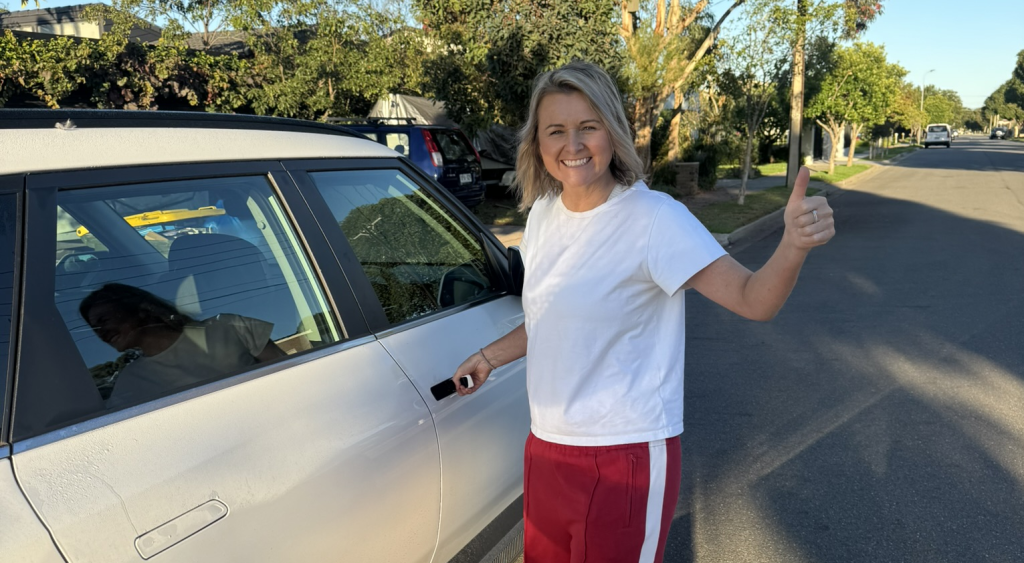
We’d planned the drive in a petrol car. Suddenly fuel availability had us anxious, so we swapped to a Kia EV5 and headed east.
What followed was 3140km from Adelaide to Katoomba and back, and one of the best road trips I’ve ever taken. Not despite being in an EV. Because of it. There’s a way people used to road trip before highways took over and towns became something you passed through rather than stopping in. Turns out hitting the road electric is a good way to rediscover it.
Pinnaroo: where the bakery used to be
The first thing you notice in an EV is where you stop. Not an edge-of-town servo, fuel up, leave. You stop in the middle of things. Main streets, near bakeries, outside local boutiques – because that’s where someone (RAA, in this case) put the charger.
The wide main street and grand buildings show what Pinnaroo once was. The bakery closed a couple of years ago. “Made a big difference to our town,” the locals said. The café is holding on. EV charging might just be the reason people stop by again.
Ouyen: the vanilla slice that earned its reputation
We stopped in Ouyen before tackling the Hay Plains – a long, exposed stretch of road where you don’t want to be guessing your range. Once declared home to Australia’s best vanilla slice, I’m not here to disagree. If you’re ever passing through, do yourself a favour.
Hay: what the highway doesn’t show you
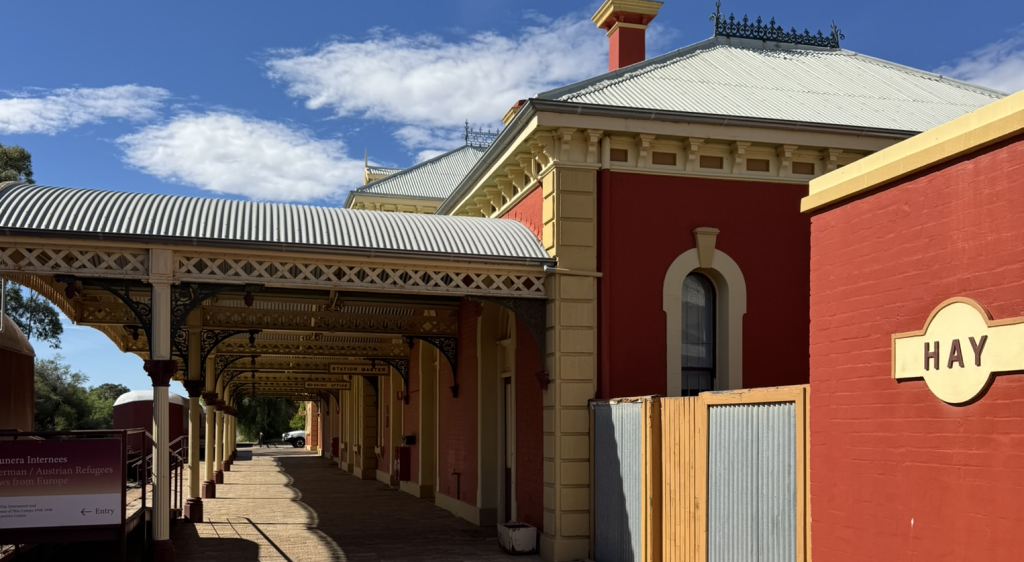
My travelling companion David has driven through Hay at least twice a year for 40 years and never once stopped, the way you do when the destination is the point. But we needed to charge and the charger was on the main street. The rest was luck.
We found the Dunera Museum. Housed in the very carriages that brought wartime internees here in 50C heat, the museum tells the story of the almost 2000 British-based Jewish refugees shipped to Australia as ‘enemy aliens’ during World War II. Fifty-seven days at sea, straight onto a train, to a town in the middle of nowhere. A move that probably saved their lives. A story not widely known outside of Hay.
Put that charger at a highway servo and we’d have driven straight past Hay just like David had for 40 years. Instead, we stayed the night.
West Wyalong to Bathurst: from a bullock trail to a racing circuit
In West Wyalong, we plugged in and walked a block to the famously crooked main street, modelled on an old bullock trail. Excellent coffee, freshly made sandwiches. We shuddered to think what we’d have eaten at the highway servo instead.
From there, the landscape began to shift. By Bathurst we were in different country entirely and motorsport enthusiast David marked the occasion by taking the EV around Mount Panorama at sunrise (within the speed limit, naturally).

Lithgow and the Blue Mountains: glowworms and gorges
From Bathurst we travelled to Lithgow and along more than 50km of unsealed road into Wollemi National Park in search of a legendary glow-worm tunnel. If you brave the 200-metre pitch-black walk with nothing but a railing to guide your way, you’ll be treated to a spectacular starry ceiling of glow-worms. Getting there is not for the faint-hearted. Rough terrain, hand-carved tunnels, the kind of road that makes you wonder if you’ve made a terrible decision. We hadn’t.
And then, finally, Katoomba. For two days we walked thousands of steps on cliff edges and rode the world’s steepest passenger railway to views that stop you mid-sentence. Bonus points to the EV: descending the Blue Mountains, regenerative braking gave us another 30km of range. Not a trick any petrol car can manage.
Bowral and Goulburn: duck, platypus, sheep
Bowral is Don Bradman’s childhood home, though nobody wanted to talk about cricket. Unplugging the car after dinner at the local RSL, the EV community found us; Tesla drivers comparing notes and a retired Victorian couple who drive to NSW and Queensland. Strangers with a shared language, swapping stories around a charger in a car park.
Ten minutes down the road to Berrima, we found a Georgian village frozen in the 1830s, Australia’s oldest pub and the gloriously scenic Wingecarribee River where platypuses apparently outnumber tourists.
We pushed on to Goulburn and the Big Merino, which was relocated from the town centre to the highway in 2007 because no-one was seeing it. If there’s a better metaphor for this entire trip, I haven’t found it.
Wagga Wagga: the penny drops with an overnight charge
On a detour to a friend’s farm outside Yass, we heard of a farmer using a Tesla as their paddock vehicle. We thought of the Hay locals who’d told us EVs were “only for city folk”.
A quick hello to the dog on the tucker box at Gundagai before arriving in Wagga Wagga, home to an inland river beach that made Tourism Australia’s top 20 beaches. Our motel had a free overnight charger; we woke to a full battery and effectively saved $50 on the room rate. Find accommodation with overnight charging and the economics of EV travel shift completely.
Jerilderie: the one that got away
Jerilderie is where Ned Kelly locked up the local police, dressed his gang as officers and robbed the only NSW bank the Kelly Gang ever held up. The town is home to 17 Ned Kelly heritage sites, his Jerilderie Letter and a reportedly good bakery. We didn’t get to any of it.
The only charger was out of town with nothing around it. Impatient, we left without a full charge. A perfect example of the cost of poor charger placement and the opportunity that remains.
Wycheproof, Horsham and Dimboola: small towns, big lessons
Over the border in Victoria, Wycheproof surprised us. The world’s smallest registered mountain is here although at 43 metres, it’s easy to miss. What you can’t miss is the railway line down the middle of the main street; used by harvest freight trains since 1883, creeping through at 15km/h without boom gates or warning bells. And not a single accident in more than 100 years.
A high-speed charger sits on the main street too. We sampled the bakery during our 30-minute charge and were back on the road before you could say “Wycheproof”.
We took a detour to Horsham as Dimboola’s only charger was slow and we realised too late it was a 50-minute walk from our accommodation. Note: find the charger, then book the accommodation.
Dimboola’s Victoria Hotel is the kind of pub that makes you pull up a stool and cancel your plans – built in 1924, trailing grapevines, a grand vintage dining room and country welcome. The town will get a fast charger one day and more people will find their way to the pub.
Keith: last charge, long thoughts
Back into South Australia, we stopped at Keith for our last charge, inconveniently at a highway servo. We walked a kilometre to find coffee – a final reminder that the right charger in the right place matters.
As more people drive EVs and charging infrastructure catches up, these towns won’t just survive, they’ll have reason to thrive again. The wide main streets, the grand old buildings, the people and the stories, all waiting for travellers with 30 minutes to spend on a main street instead of five at a highway service station. Somewhere between the vanilla slice, the glow-worms and the Hay museum, we rediscovered how road trips used to feel, and why the towns lining these routes deserve to be part of them again.