

Weaving past with present in the Hills
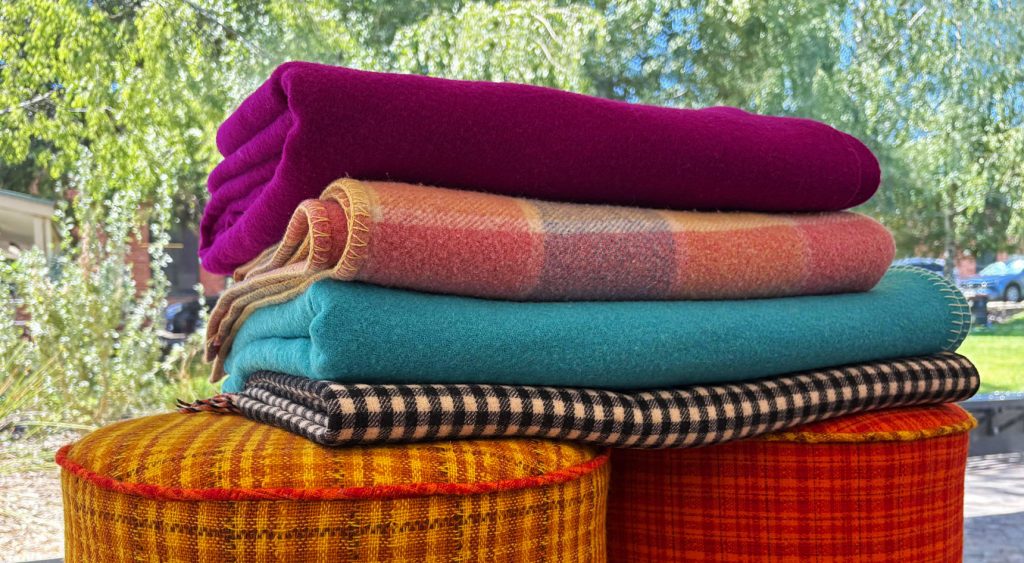
Rifling through your linen closet (or your grandma’s), you may find an iconic piece of South Australian history.
Perhaps a thick, woollen blanket or picnic rug, or maybe even a lightweight airline knee rug lifted from an early Ansett flight. If you spy a label proudly professing it as an “Onkaparinga” production made in Australia, you’re holding a treasure from South Australia’s past.
Once, the clatter of machinery filled the small Adelaide Hills town of Lobethal, resounding from the Onkaparinga Woollen Mill. Today, the cluster of red-brick buildings still stand beside the river. The clatter is replaced by laughter and conversation as creativity drifts through the same spaces. This is FABRIK Arts + Heritage – a place where history lingers and contemporary culture thrives.
When industry blossomed in Lobethal
FABRIK’s story began in 1872, when a woollen mill was established on the banks of a tributary to the Onkaparinga River on the traditional lands of the Peramangk and Kaurna people. Water was essential to early textile production, and the Onkaparinga River – known as Ngangkipari in Kaurna language meaning women’s river – represented both resource and setting. By 1928, the river had influenced the name of the factory when it became Onkaparinga Woollen Mill.

At the time, Lobethal was a modest agricultural settlement shaped by German Lutheran farming communities. The growth of the Mill changed everything. Large-scale manufacturing took hold, transforming the town into one of SA’s most significant regional industrial centres.
Originally named Lobethal Wool and Tweed Company, over the years it became famous for its distinctive checked Onkaparinga blankets, as well as a wide range of textiles that travelled far beyond the region.
The Mill supplied textiles during both world wars – including uniforms, blankets, and fabric – and its World War I contributions resulted in Lobethal being renamed Tweedvale for 18 years.
For more than a century, the Mill was not just a workplace and prolific manufacturer – it was the heartbeat of the town.
Life built around the looms
At its height, the Mill employed hundreds of people; sometimes close to 1000. As the Mill grew, Lobethal grew with it and the rhythms of daily life followed the pulse of production.
Social life and working life were deeply intertwined. Sporting clubs (tennis and croquet being the most popular), choirs and social groups were filled with Mill workers.
Women formed a significant part of the workforce, valued for their skill and precision in textile production. Skilled British workers arrived, followed after World War II by European migrants, bringing new languages, traditions and techniques that added further texture to Lobethal’s identity.
A new creative chapter
When the Mill closed in 1993, the town felt the loss deeply. The looms stopped, and a defining chapter came to an end.
Adelaide Hills Council acquired the site, and slowly it began to evolve. First, it became a hub for start-up opportunities. Small food, wine, engineering and craft businesses moved in and markets popped up. Temporary exhibitions and informal museum displays appeared. Locals continued to gather, drawn by habit, nostalgia and possibility.
The turning point came in 2015, when local arts organisation h.ART began activating the old Mill buildings with exhibitions, performances and cultural events.
Community consultation followed and in 2018, Adelaide Hills Council committed to developing the precinct as a permanent arts and heritage hub. The name FABRIK, taken from the German word for factory or mill, honours both the site’s industrial textile past and Lobethal’s German heritage.
Renewal in the Hills
After the devastating 2019 Cudlee Creek bushfires, government recovery funding and Council investment supported a major redevelopment of the site.
Restored historic buildings have retained their industrial character, while contemporary additions – most notably a light-filled glass retail pavilion – have created open, welcoming spaces. Event spaces sit beside workshop spaces, with studios and even accommodation for artists in residence.
FABRIK officially reopened in September 2024, marking the beginning of a new era for the site.
Visiting FABRIK today
For travellers exploring the Adelaide Hills, FABRIK Arts + Heritage is both a destination and an opportunity to pause, slow down and soak up local culture.
Visitors can wander through galleries showcasing exhibitions and contemporary textile art, peek into publicly accessible artists’ and makers’ studios and watch creativity in action. Museum displays throughout the buildings tell the story of the Mill, the town and the people who shaped this place.
The retail pavilion offers a carefully curated selection of South Australian art, textiles, homewares and artisan goods – perfect for thoughtful souvenirs. Throughout the year, workshops, markets, exhibitions and artist residencies bring the precinct to life, making each visit slightly different from the last.
FABRIK also continues to play an important role providing opportunities for the community to come together, and share the experience of being creative.
No visit to the Adelaide Hills is complete without stopping by the heritage woollen mill site. In these buildings where iconic blankets were once made, FABRIK is now weaving its own story.
During February 2026, RAA members visiting FABRIK Arts + Heritage can receive a special gift. Show your RAA membership card in the Gallery Shop and mention the code RAA+FABRIK to claim your free A5 journal, a perfect little something to keep for yourself or to give to someone special.
Ready to thread your way to something art-ful?
Explore art side-by-side with history and heritage at FABRIK.