

Meet Marion
Before the first English settler ships moored in Holdfast Bay, the Marion area was home to the Kaurna people.
The Warripari (Sturt River) and surrounding bushland provided a smorgasbord of food, along with material for building shelters and making tools and baskets.
The sharp river bend just south of Sturt Road was an important meeting place known as Warriparinga, meaning “windy place by the creek.”
It’s now an idyllic park with magnificent eucalypts, a wetland, sculptures and an extensive lawned area.
It’s also home to the Living Kaurna Cultural Centre, which has an art gallery and gift shop, and hosts a range of cultural tours.
European settlers were soon drawn to the river’s water supply and surrounding fertile soil. Only two years after the first fleet’s 1836 arrival in Adelaide, Surveyor-General Colonel William Light’s team had surveyed the village of Marion.
The origin of the suburb’s name is unclear, but some historians believe it was named after the daughter of the state’s first Resident Commissioner, James Hurtle Fisher, although her name was Marianne.
Before 100-year-old Marianne Fisher passed away in 1927, she was the last surviving passenger from the HMS Buffalo – the most well-known ship in South Australia’s first fleet.
Adelaide’s garden
In the early days, most of the area was taken up by market gardens, vineyards and fruit and almond orchards.

The now-renowned Hamilton wine family planted extensive vineyards and by 1841 they’d established one of the state’s first commercial wineries – some say the first.
In 1843, grape grower Samuel Keane bought a massive 240-acre (97-hectare) tract of land, sight unseen, from his Liverpool home in England. His property lay within the area now bounded by Oaklands Road, Marion Road, Morphett Road and Dwyer Road/Railway Terrace, with only the small, surveyed village of Marion precluded.
Oaklands, the 22-room house Keane built, was the largest mansion in the state at the time. It was demolished in 1967 in anticipation of a MATS plan freeway that never eventuated, and the buried wreckage lies beneath the Oaklands Estate Reserve car park.
Of all the vines planted in the district, only a few remnant vineyards remain, including:
- Marion Heritage Vines on the corner of Oaklands Road and Hendrie Street, Park Holme, beside Marion Outdoor Pool.
- A small vineyard on the south-east corner of Oaklands Estate Reserve in Oaklands Park.
- A sliver of vines at the end of Warriparinga Way, beside the Living Kaurna Cultural Centre in Bedford Park.
These vines are now maintained by Patritti Wines in Dover Gardens.
From the 1930s to the 1950s, busloads of interstate visitors arrived in late winter and early spring to enjoy a snow-like wonderland of almond blossoms.
At the height of this agricultural venture, Marion supplied a third of Australia’s almonds. Historic almond orchard enthusiasts can view a remnant stand of trees in Oliphant Avenue Reserve, Marion.
Bustling ‘burb
By the 1950s, housing development was rapidly replacing the district’s farmland. The Sturt River’s seasonal flooding, which once irrigated the market gardens and orchards, became a nuisance to homeowners.
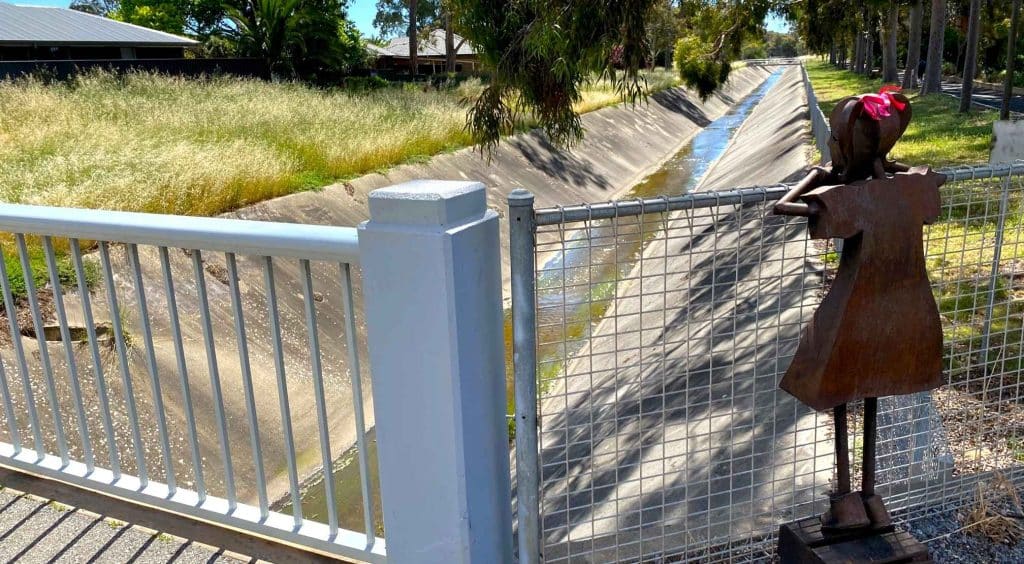
The South-Western Suburbs Drainage Act 1959 was implemented between 1960 and 1971, and saw the river become a concrete-lined channel from Sturt Road, Bedford Park to the Patawalonga Creek at Glenelg North.
The Sturt River Linear Park Trail follows the river past historic sites, parks and playgrounds from Main South Road, Darlington to Pine Avenue, Novar Gardens.
Walking the past
History buffs can explore Marion Historic Village on the 2km-long self-guided heritage walk. The trail passes several historic sites and other features, including:
- The old Marion Hotel, built in 1851.
- The remnant almond trees in Oliphant Avenue Reserve.
- The brickwork’s manager’s cottage (circa 1900) beside George Street Reserve, which was once a pug hole for sourcing brickmaking clay.
- Light Square, honouring Colonel William Light (local streets, including Finniss, Nixon and Jacob are named after partners in Light’s surveying firm. Boyle Travers Finniss later became SA’s first Premier).
Walkers can also enjoy a Pokémon-esque hunt for five Little Marion sculptures (main image) dotted along the trail. Created by sculptor Gerry McMahon, the art installations were inspired by Margaret Pill’s (nee Western) memoir Yesterday’s Child, which recalls her time growing up in Marion in the 1930s.