

Is your bike or e-scooter helmet legal?

You’ve been overseas and bought a quirky bike helmet at a local market. But is it legal to use in Australia?
In 1990, Victoria was the first Australian state to introduce mandatory bike helmet laws, followed by the rest of the country in the next couple of years.
An extensive mid ‘80s Federal Government campaign prepared the public for the new laws by spreading the word that helmets were cool.
The Australian Road Rules say cyclists must wear an approved, securely fitted and fastened bike helmet, unless the rider is exempt.
The South Australian Road Traffic Act says Sikhs wearing a turban don’t have to don a bike helmet.
Helmets for bikes and other personal mobility devices, including e-scooters, e-skateboards and e-solo-wheels must comply with one of these Australian or overseas standards.
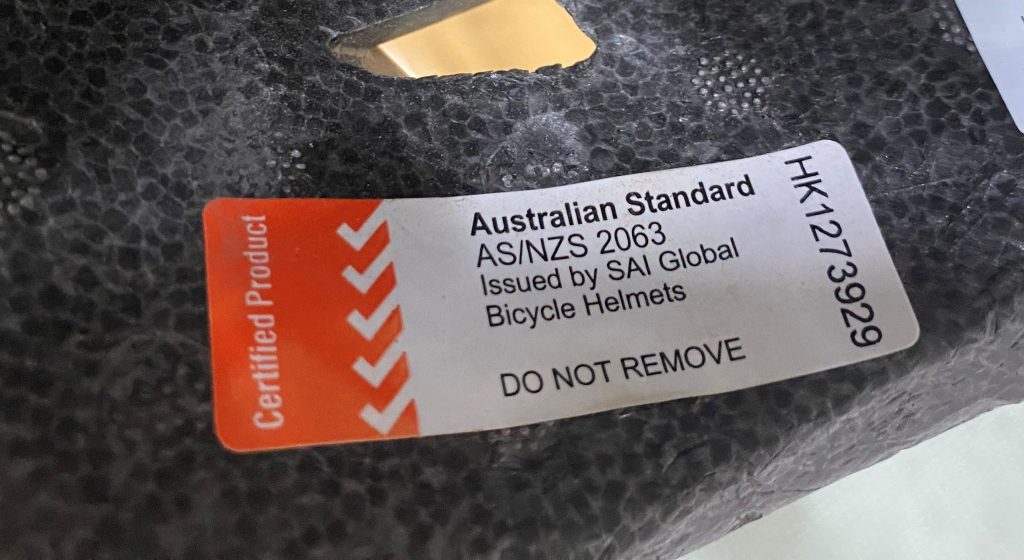
- Australian/New Zealand Standard AS/NZS 2063:2020
- Australian/New Zealand Standard AS/NZS 2063:2008
- European Standard EN 1078:2012+A1:2012
- United States Consumer Product Safety Commission Standard (16 C.F.R. Part 1203)
- American Society for Testing and Materials standard (ASTM) F1447-18
- Snell B-95, 1995 Bicycle Helmet Standard, 1998 revision
Helmets that comply with these standards have been tested at specialised laboratories for construction quality and impact absorbing properties. They must display the relevant certification mark and include instructions for use.
Penalties
A cyclist or personal mobility device rider who fails to wear an approved, securely fitted and fastened helmet could be fined $129, plus a $105 Victims of Crime Levy.
Selling a helmet that doesn’t comply with the regulations attracts an expiation fine of $472, plus a $105 Victims of Crime Levy, with a maximum court-imposed fine of $2500.
Maybe, maybe not
Anybody who’s bought a Gucci bag, Hilfiger shirt or The North Face jacket at an overseas night market are pretty sure they’re not getting the real deal.
So, keep that in mind before spending the equivalent of $3.50 on a fancy new bike helmet.