
Car review: Toyota HiLux
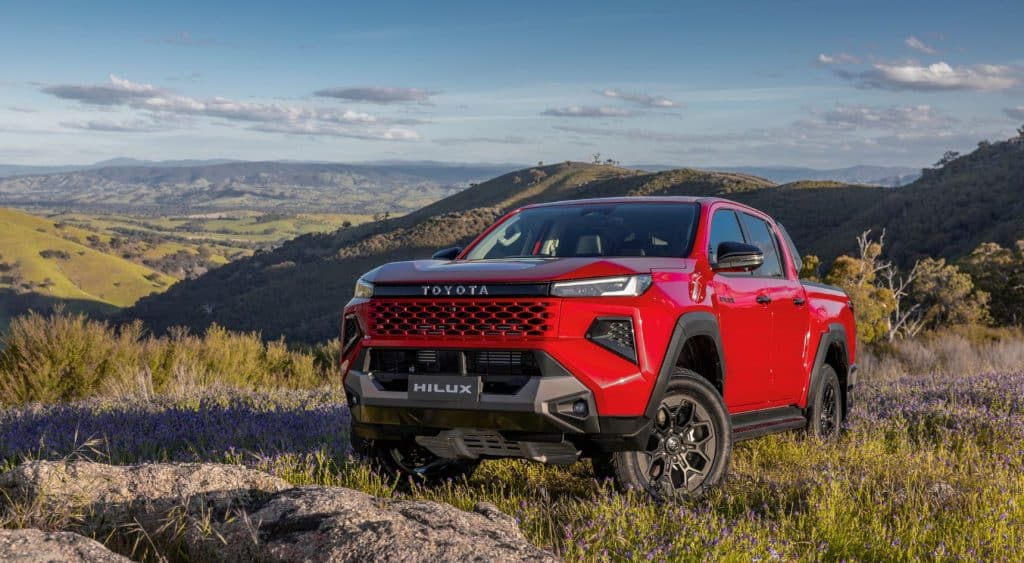
Toyota’s all-conquering HiLux is facing the greatest threat to its dominance in its 58-year history.
Australia’s best-selling new vehicle from 2016 to 2022, the HiLux – which has more recently sparred with Ford’s locally developed Ranger – now faces competition from highly competent and sometimes cheaper foes produced by upstart brands like BYD, MG, LDV and Kia.
Some of these new competitors might not be able to tackle the gnarliest off-road tracks as well, tow as much, or carry as much in the tray. However, they typically drive better day-to-day, pack more tech and are more comfortable.
Features
To stave off this onslaught of rivals, Toyota’s ninth-generation HiLux is here with new ‘Cyber Sumo’ exterior styling, which blends sharp, futuristic styling with a wide body. Toyota has used an entirely new interior and warmed-over powertrains, with a fully electric version set to join the range this year.
Fundamentally, the new HiLux is still the same 10-year-old HiLux underneath, but Toyota would say it’s taken an ‘if it ain’t broke’ approach with its highly proven underpinnings. The newest HiLux looks a lot more modern outside, and the interior is night-and-day better.
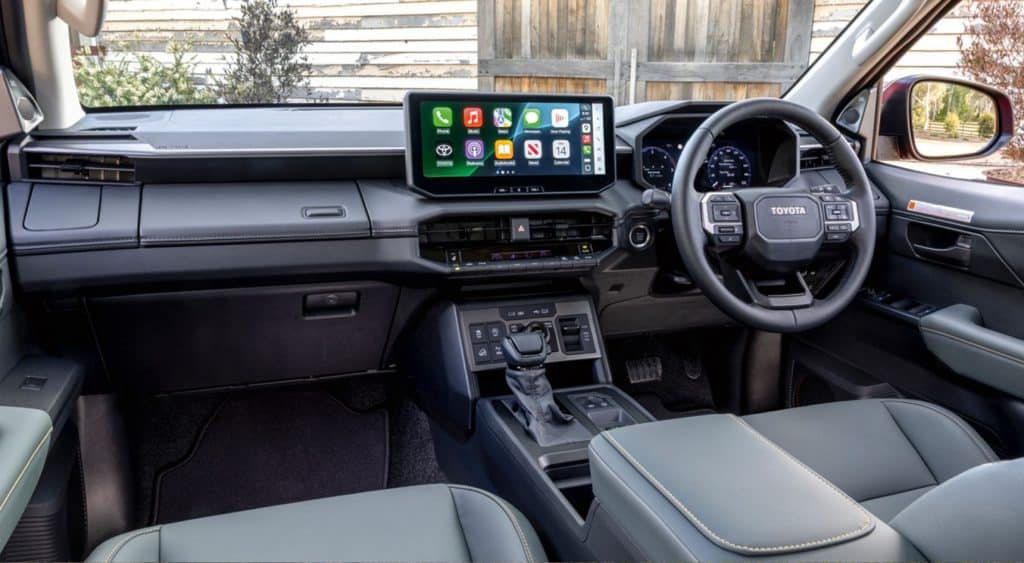
Climb inside and it’s a breath of fresh air compared to the previous car’s interior, with contemporary straight lines, a 12.3-inch infotainment screen (with wireless Apple CarPlay and Android Auto, and a wireless phone charger) and a well-judged mix of hard buttons for key controls, such as the air-conditioning.
On the road
On the road, the HiLux drives similarly to the old one. Rugged and burly, the largely carryover 150kW/500Nm 2.8-litre turbodiesel four-cylinder engine isn’t especially brisk. It’s still a workhorse in cocktail garb and the firm, live-axle rear suspension is always reminding you that it’s ready for that circa-one-tonne payload or 3.5-tonne caravan, even on a trip to the shops.
New electric steering makes parking easier, while overall it’s a bit quieter and more refined. HiLux now comes with just about every active safety feature, from autonomous emergency braking with cyclist, pedestrian and motorcyclist detection, to semi-autonomous adaptive cruise control.
Toyota says efficiency is also better, although despite the 48-volt mild hybrid system, there still isn’t a full hybrid model. Our manual test car (which doesn’t have the mild hybrid tech) used 8.5L/100km in the city and 7.6L/100km on a freeway run.
Prices have crept up a couple of grand and our mid-to-top-spec six-speed manual SR5 will set you back $63,990 before on-road costs. The automatic, mild-hybrid Rogue tops the range alongside the off-road-focused Rugged X at $71,990 before on-roads.
While utes from other challenger brands feel built to last a decade at best, you still get the sense that your children could hand down your HiLux to your grandchildren. In a world of instant gratification, only sales will tell how much that still appeals to new-vehicle buyers in 2026.
| Specs | |
|---|---|
| Price | $33,990–$71,990 |
| ANCAP safety rating | 5 stars (2025) Rating excludes Rugged X |
| Warranty | Five-year, unlimited-kilometre warranty |
| Range | 546km |
| Fuel consumption | 7.6L/100km |