

South Australia’s silo art
 Casting lengthy shadows on the golden crops below, wheat silos have become synonymous with our image of regional Australia.
Small country towns are marked by the concrete pillars, accompanied at times by only the local pub and the post office. In recent years, they’ve become towering works of art, transforming regional communities.
Silo art is a phenomenon Australia’s country towns are embracing. Beginning in Western Australia in 2015, it’s an initiative that’s since spread across the country. Painters and projection artists, both local, interstate and overseas, are turning silos into works of art. Here in SA, we have 8 sky-scraping country canvases.
While hard to miss in theory, finding one has been a case of luck and circumstance until recently. These days, there’s a dedicated trail – the Australian Silo Art Trail – all thanks to the hard work of one very passionate WA local, Annette Green, and husband Eric.
In 2018, Annette set out to record every silo she discovered on their travels around Australia in their converted camper-bus.
With the help of other travelling Aussies in a Facebook group, she created a comprehensive online guide of all 35 silos (and counting), as well as a series of downloadable and printed maps of each state.
Casting lengthy shadows on the golden crops below, wheat silos have become synonymous with our image of regional Australia.
Small country towns are marked by the concrete pillars, accompanied at times by only the local pub and the post office. In recent years, they’ve become towering works of art, transforming regional communities.
Silo art is a phenomenon Australia’s country towns are embracing. Beginning in Western Australia in 2015, it’s an initiative that’s since spread across the country. Painters and projection artists, both local, interstate and overseas, are turning silos into works of art. Here in SA, we have 8 sky-scraping country canvases.
While hard to miss in theory, finding one has been a case of luck and circumstance until recently. These days, there’s a dedicated trail – the Australian Silo Art Trail – all thanks to the hard work of one very passionate WA local, Annette Green, and husband Eric.
In 2018, Annette set out to record every silo she discovered on their travels around Australia in their converted camper-bus.
With the help of other travelling Aussies in a Facebook group, she created a comprehensive online guide of all 35 silos (and counting), as well as a series of downloadable and printed maps of each state.
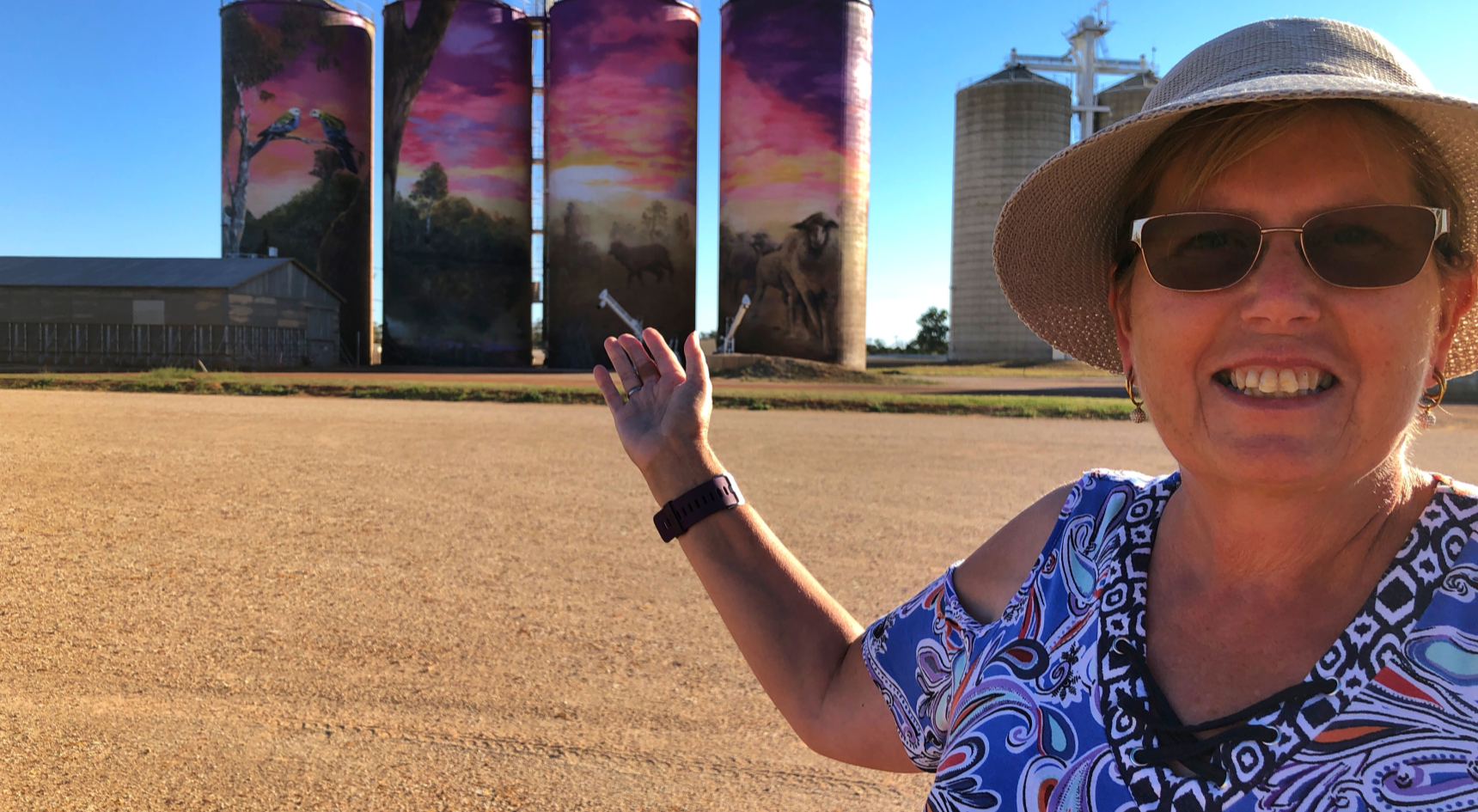
Annette Green on the Silo Art Trail. Image: supplied
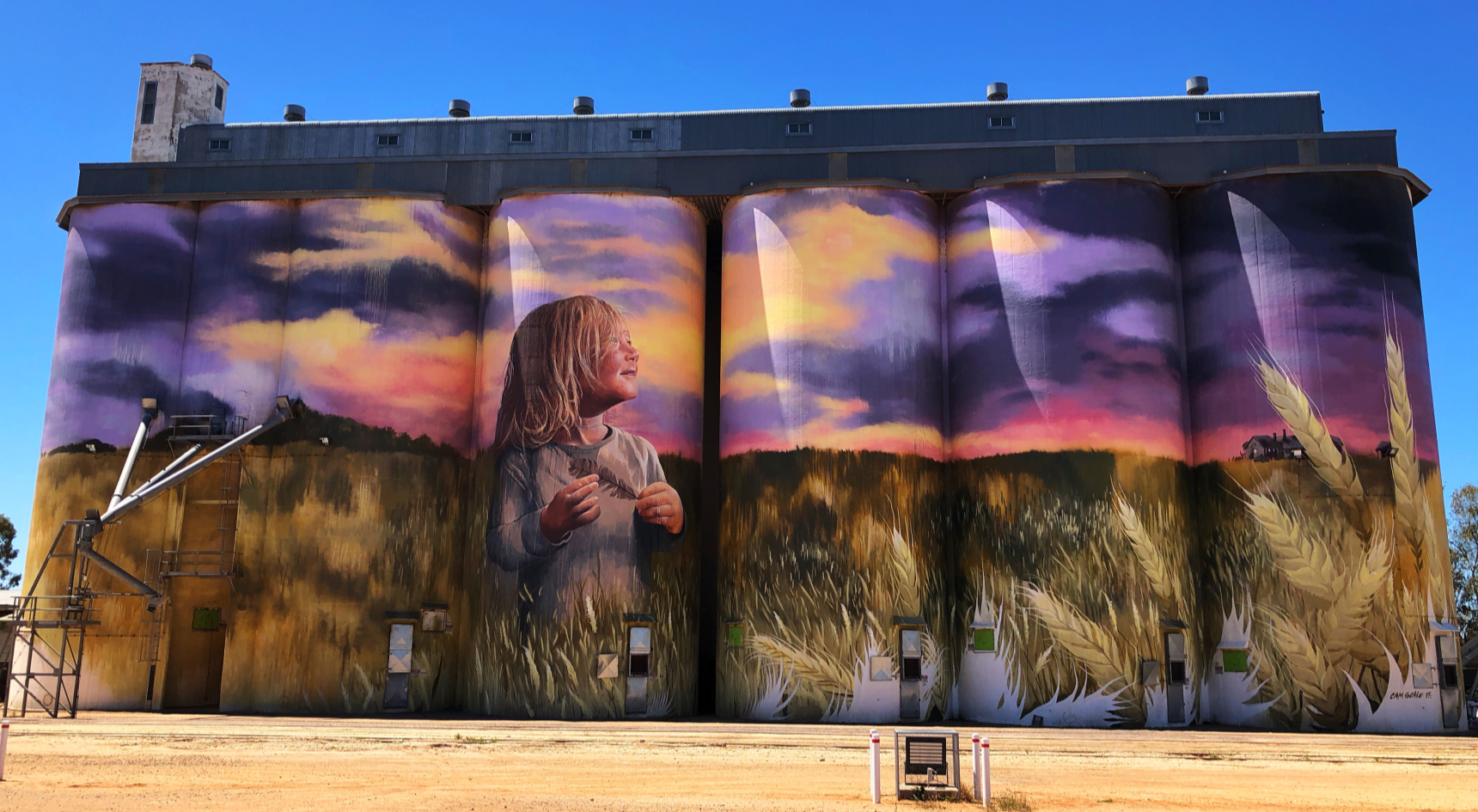
Kimba silo art, by Cam Scale. Image: Annette Green
Cam Scale, Kimba
One of the most photographed of the South Australian silos, Kimba was painted by Sydney-born graffiti-artist turned muralist, Cam Scale. Cam completed the works in August 2017, an initiative of the Igniting Kimba group in an effort to bring tourism back to the regional township. “It was my biggest job to date, and I think it still is,” he says. “It’s about 25m tall, by 60m wide. It was a fairly big undertaking.” The mural runs across 6 silos, depicting a young girl in a wheat field at sunset. “There was a lot of community engagement – lots of ideas put forward and then we whittled it down to a recurring theme.” “In Kimba, this was around the farming community, the youth and looking towards a brighter future – that’s how this work came about.” Cam says it was important the community could relate to the work. “I picked an image that resonates with people, and that they take away their own feelings from. It’s a universal picture that people seem to have enjoyed.” Taking a month to complete (aside from 7 days lost to bad weather) and over 200L of paint, the mural was painted using a scribble grid technique, where the design is broken down into a number of sections. “It’s actually a lot bigger than you think it’s going to be, because there’s more surface area with the curve of the silos,” he says. “The image is also going to distort slightly, depending on where you are viewing it from.” Aside from the logistics, Cam says the weather creates yet another challenge. “High wind can cause a real problem, and you’re up on a lift to reach high sections, wearing a harness.” But he says it’s well worth the hurdles. “It’s a wonderful experience, and you’re in the town for such a long time. You spend time at the pub and get to know a lot of people – everyone is so welcoming. It’s one of the joys of this career.” He says the silos are more than just a work of art for these regional communities. “Often you’ve got people moving away from the towns, or roads no longer cutting through the towns, so giving people a reason to take a detour really helps small businesses and the community.”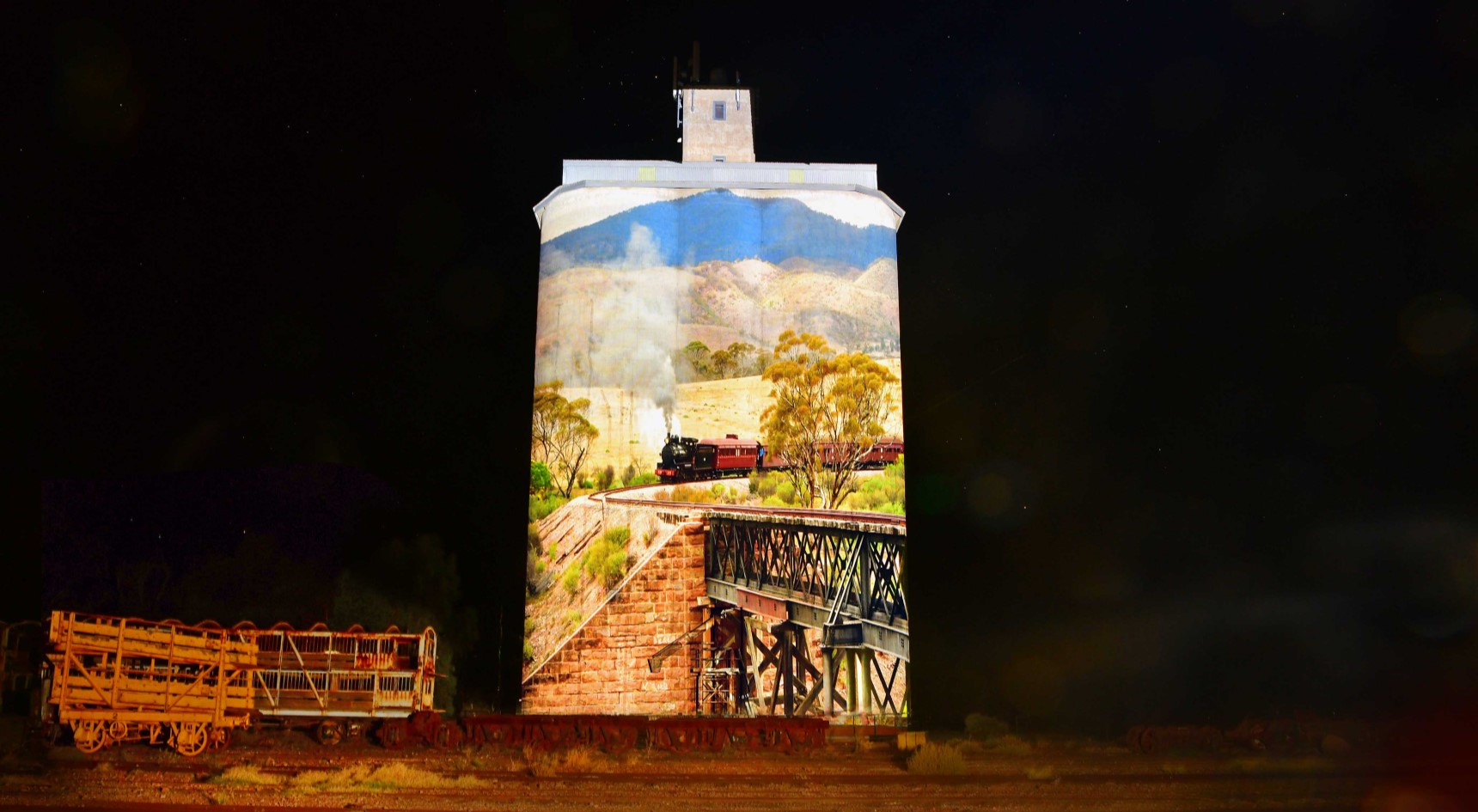
Quorn silo, projection by Illuminart. Image: Paul White
Illuminart, Quorn and Karoonda
The silos at Quorn and Karoonda both feature artworks with a difference – they use projection technology to beam art onto the walls. SA-based projection art company Illuminart is behind the permanent installations, which founder Cindi Drennan says are close to her heart. “Quorn is my hometown, so when they were thinking about developing tourism in the area, they asked if Illuminart would be involved,” she says. “It’s a really huge honour when your hometown asks you to do something like this.” It’s been a long time in the making, taking almost 4 years to get off the ground, quite literally. The projection features a short show to start, playing every night after sunset. A combination of film, artwork and animations, it’s ever-changing, with the aim to explore stories of the town, Indigenous and ecological facts, rail history, and an intriguing story about the Quorn Country Women’s Association during World War II. After this, there’s an exhibition of artworks, photos and imagery sourced from community members. “It tells the history of the town and some of the quirky qualities of the place, the culture and the geology,” Cindi says. “People can come at sunset, bring their snacks and nibbles, and it’s on early enough so they can go to the pub afterwards.” There are a few chairs there, or you can bring your own. The Karoonda silos also feature an ever-changing projection by night, all driven by local council and the community. By day, you can marvel at the mural painted by Mongolian-born Melbourne artist HEESCO. Illuminart also has a permanent silo installation in the works at Wallaroo, as well as a number of different projection projects around the state in locations including Barmera, Mount Gambier and Victor Harbor. “The regions are wonderful places to live, but a person who’s driving in a car from A to B will never really gain an insight into what makes that place special unless they spend a few weeks there talking to the locals,” Cindi says. “That’s what I love about these projects – they go into the heart of the community, expressing them through art, and sharing with people what it’s like to live there.”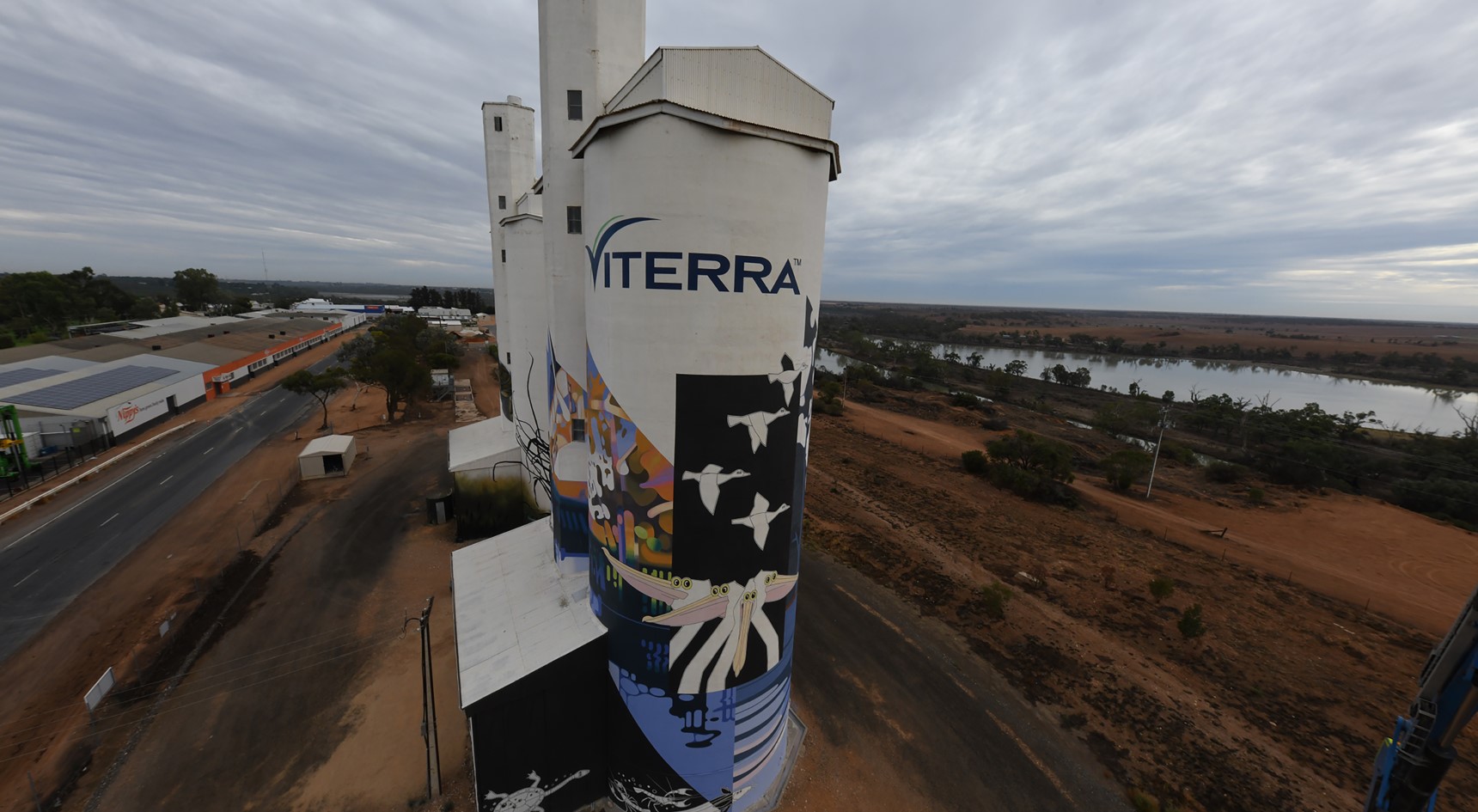
Waikerie silo art, by Garry Duncan. Image: Bruce Mouatt