

When complacency can kill
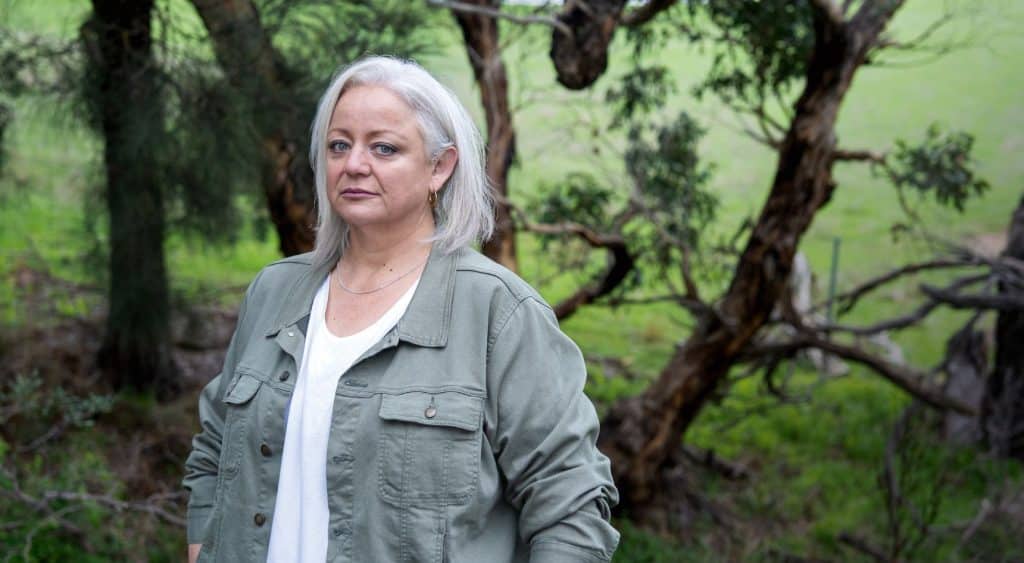
It’s been nearly 30 years since Jodi Clerke was found in a ditch after falling asleep at the wheel and slamming into this tree (pictured above) at 85km/h, just a few streets from her front door. Jodi was barely six kilometres and less than 10 minutes from her driveway. It’s a miracle she’s alive to tell her story; one that hits far too close to home.
Jodi Clerke was just 19 in 1997 when she was returning home to Strathalbyn on the Fleurieu Peninsula from her sister’s in Hackham, desperate to get to her volunteering job after a night as designated driver for her mates.
“I was always a designated driver when we went out,” Jodi, now 47, says. “I remember stopping to buy strawberry milk and that’s it.”
Police reports suggest Jodi fell asleep while driving, resting her foot on the accelerator and crashing close to home. She was found by her neighbour Jim who, to this day, lives just a couple of streets from her.
“Jim was leaving Strathalbyn as I was coming in,” Jodi says. “He drove past and saw the tail lights of my car and steam coming up from the bonnet. “I had a few corners left and then it’s a straight road all the way to my house.”
Jodi’s story may sound familiar. Most people have probably driven the roads around their home more times than they can count. The dirt corner on Paris Creek Road is a spot Jodi knew well and a route she’d taken hundreds of times before.
“You go into autopilot the closer you get to home. The more relaxed you are, the more you don’t pay attention to the road because three more turns and you’re home, right? Your body goes into relax mode.”
That’s exactly what happened just minutes from Jodi’s home when the engine from her white Datsun 180B bounced off her thigh and ended up in the passenger seat. Three millimetres closer to the centre of the car and she would have been crushed and killed instantly.
Jodi’s knees were stuck under the dash, her lungs collapsed and her voice box was broken along with her collarbone, arms and hip; even her thigh bone broke through the socket, shattering her rib cage. Every part of Jodi’s body was damaged except her head. However, most of Jodi’s injuries probably pale in comparison to her flatlining three times that day with her heart needing restarting.
Home sweet home
For many drivers, the most dangerous part of a journey isn’t the highway stretch or the unfamiliar detour; it’s the final few minutes, just around the corner from home. It feels safe, predictable and almost automatic.
Despite it being nearly three decades since Jodi’s crash, she relives it almost every day, partly because she regularly drives past the crash site in the charming town she still calls home.
“I always look at it,” says Jodi of the crash site. “It’s like reliving the moment every time. It never leaves me.”
Home truths
South Australia Police data analysed by RAA has revealed this percentage of lives lost in regional crashes between 2020 and 2024 were people living in the regions.
The road to recovery has been long, emotionally and physically. “It was so traumatic that even my hair went white overnight,” Jodi says. “By the time I left the hospital, the whole crown of my head was white and, at 19 having white hair, my whole image changed.”
Jodi also describes the trauma she created “outside of herself” especially coming from a small town.
“Mum had to watch me bleed out, the two firies who pulled up to the scene went to school with me, the police officer was my mum’s friend who I’d known since I was five and, if my neighbour left home five minutes earlier, he would have crossed my path and died,” Jodi recounts. “The crash never just impacts you.”
The comfort of home disappears in an instant. Jodi was moments from making it to her driveway but, for a long time after the crash, that same driveway made her feel like a prisoner because she felt trapped and refused to get back in a car.
Whether driving a road you know like the back of your hand or one you never knew existed, Jodi says anything can happen. “I drove that road down to town every weekend for parties and work,” she says. “While you know the road, you’re a user on the road and that road always changes.”

When a route becomes routine
Have you ever driven on a road so many times you could memorise each corner or bump? Maybe you’ve driven through an intersection and can’t remember whether the lights were green or red?
According to RAA Senior Manager of Safety and Infrastructure Charles Mountain, when a route becomes routine, drivers often operate on autopilot: scanning less, reacting slower, and underestimating risk.
“Familiarity and complacency are common factors which can lower a driver’s level of concentration,” Charles says. Fatigue can often compound this effect, dulling reaction times precisely when attention should remain sharp.
“Jodi’s experience is a stark reminder that even the most familiar roads demand full concentration until the engine is off and the keys are out,” Charles says. “It’s important not to fall into the trap of thinking that just because you’ve driven the same road many times, it doesn’t mean you can disengage.
“Don’t take any journey for granted, even the shortest drive over the most familiar roads.”