
What does ‘local traffic only’ mean?
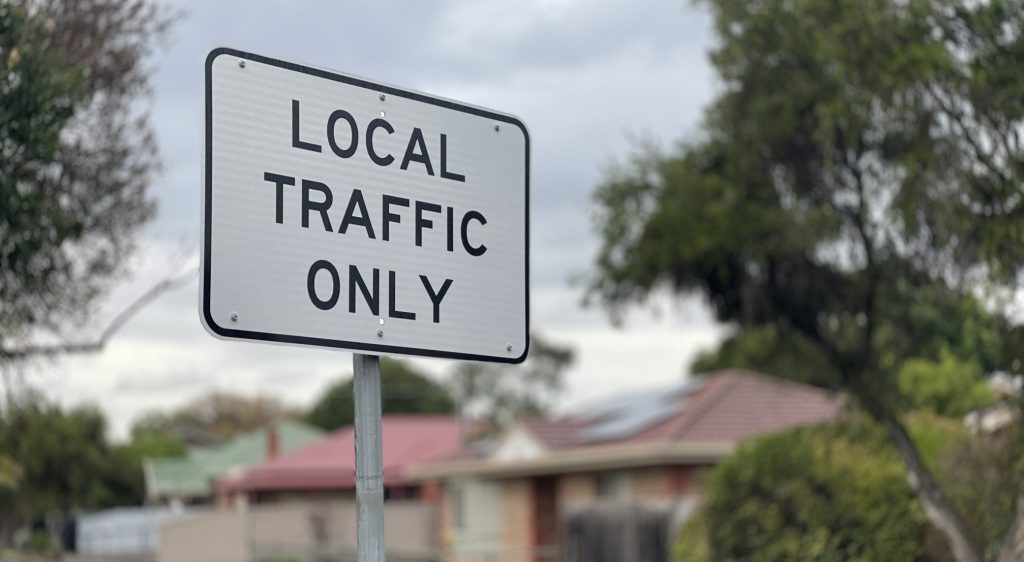
Your navigation app suggests a shortcut down a quiet suburban street, but as you approach, there’s a sign that says, ‘local traffic only’. Can you drive here?
If you live there, absolutely – you are the local traffic. The same goes for family, friends, tradespeople, delivery drivers and emergency services.
But here’s the surprising part. In South Australia, technically anyone can drive down a road marked ‘local traffic only’.
Just because you can doesn’t mean you should
Unlike regulatory signs like stop, give way or speed limit signs, ‘local traffic only’ is designed to deter through traffic, not ban it. The sign is advisory, not regulatory, so it can’t be enforced by council or SA Police on its own. This is also the case in other Australian states, where authorities classify it as a courtesy heads-up, not a law.
But here’s why it’s worth taking the hint.
1. Ignoring the sign can be more trouble than it’s worth
These roads often have ‘local traffic only’ signs in place because of roadworks, lane closures or difficult layouts that make them unsuitable for through traffic.
Non-local drivers may find themselves navigating obstacles like traffic cones and bottlenecks, making awkward U-turn manoeuvres and facing delays that could’ve been avoided by sticking to the main route. If the shortcut is also on everyone else’s navigation app, you won’t be the only one who had the idea, and what looked like a quick escape can turn into a slow-moving queue.
2. It affects the people who live there
For a non-local, taking this route may mean getting to the destination a bit quicker. But for residents, a steady stream of cut-through traffic means noise, fumes, congestion and sometimes being unable to get out of their own driveway.
These are residential streets, not arterial roads and traffic can negatively impact residents when a quiet street becomes an unofficial shortcut.
3. The road may not be built for it
Narrow streets, blind spots, and proximity to schools are common reasons these signs are in place. Residential streets are designed for low, slow and local traffic and not as alternatives to main roads. Add on-street parking on both sides and there’s little margin for error when two cars come face-to-face, plus pedestrians and kids on bikes and the safety risk can increases quickly.
What about walking, cycling or scooting?
Pedestrians, cyclists and e-scooter riders aren’t legally prohibited either, though cyclists and pedestrians should use the footpath were possible. Mobility scooter and motorised wheelchair users are treated as pedestrians under law. Happen to be riding a horse? Horses count as vehicles, so unless you live there, probably best to keep your pony on the main road.
Is it ever enforceable?
As a standalone sign, not usually. But when paired with regulatory signs, it can be. If ‘local traffic only’ appears alongside ‘road closed’ or ‘no entry’, those accompanying signs are enforceable. A car navigating through these areas might be heading to their driveway. A non-local might be driving straight into a dead-end, and potentially a fine.
To paraphrase Jeff Goldblum: “You were so preoccupied with whether or not you could, you didn’t stop to think if you should.”
You can drive down a ‘local traffic only’ street if you don’t live there, but it’s often a shortcut that’s not much of a shortcut at all.